

Off-Page SEO: Everything You Don't Control
Last time I said on-page SEO was the half that's entirely in your hands. This is the other half.
Off-page is what the rest of the internet says about you, and you don't get a vote. You can't write your own reviews. You can't decide who links to you. You can only do things that make other people want to talk about you, and then wait.
Which makes this the tricky part. Not because it's complicated, but because the lever is indirect.
1. What people say about what you actually do
This is the obvious one, so I'll be quick.
If you sell skis, then what's your service like? What are your prices? What's the general feeling when someone mentions your name?
Mostly this lives in aggregated reviews. For a business with a real address, that's your Google Business Profile, and honestly it's the single most important off-page asset you have. It's verified by Google, it's tied to a real location, and it shows up before your website does.
For everyone else it depends on your niche. Facebook reviews. G2 if you're SaaS. Reddit and Quora threads where people ask which one is worth it. Industry forums that have been running since 2009 and look it.
Find where your niche talks. That's where this signal lives.
One unglamorous thing while we're here: if you're a local business, make sure your name, address and phone number are identical everywhere they appear. Directories, your site, your GBP, old listings you forgot about. Google cross-references these. Three versions of your phone number is a small mess that costs you real rankings, and fixing it is an afternoon's work.
2. How often your stuff gets mentioned and linked to
Also fairly obvious.
Say you wrote a guide on the top 10 skis this year for beginners. Is anyone linking to it? Is it being passed around on Reddit? Did someone drop it in a Discord, share it to Instagram, send it to a friend who was buying their first pair?
Links are the classic version of this and they still matter. But mentions count even without a link. If people are writing your brand name in sentences, that's a signal, and it's a hard one to fake.
Which brings up the thing everyone forgets: your own channels are part of this too. Your YouTube, your socials, your newsletter. You don't control what others say, but you do control whether there's anything worth saying it about. A channel where you actually show up and answer questions gives people something to point at.
And the quiet one: how often does your brand get typed into Google on its own? People searching your name instead of your category is about the clearest trust signal that exists, and it's one of the few off-page numbers a small business can genuinely move.
3. Are you a source of something nobody else has?
This sounds like the second one. It isn't.
Point 2 is about your content travelling. This is about your content existing in the first place, and being the only place a particular fact can be found.
Here's my reasoning, and it's a bet on where things are heading rather than a fact I can prove.
AI has made finding information trivial. What it hasn't solved is finding information worth trusting. When a model needs an answer, it goes looking for a source, and the web is mostly the same twelve facts rewritten by people who read the other eleven versions. Genuine new information is rare, and rare things get cited.
Back to skis.
You could write "top 10 skis for beginners" the normal way. Thirty years of experience, this is what I think, here's the list. That's fine. It's also what everyone else did, and a model reading it can't tell your opinion from anyone's.
Or you could finish all ten pairs yourself, take them to the same slope on the same day in the same conditions, decide in advance what you're measuring, turn rate, speed, edge hold, whatever matters, and run the test. Then publish the numbers.
Now you're the only place that data exists.
That article gets cited by AI. It gets linked by people who wanted numbers and couldn't find any. It gets quoted in forums for years. And it's the kind of thing that builds real topical authority, because you didn't rearrange common knowledge into a new shape, you added something to the pile.
"I can't run a lab" — how to create unique content
No, and neither can most people reading this. This is where the argument usually falls apart, so let's not let it.
You don't need a lab. You need something true that you know and nobody has written down.
If you've fitted 500 pairs of boots, you know which models run narrow. Nobody has published that. If you've run a shop for fifteen years, you know when the season actually starts in your town, not when the manufacturers say it does. If you're a SaaS, you're sitting on usage data that nobody outside your company has ever seen.
Original doesn't mean scientific. It means first hand. The bar is: could someone have written this without doing what you did? If yes, it's aggregation. If no, you've got something.
Every business has one of these. Most never write it down.
What you can control in off-page SEO
I said at the start that you only have indirect influence over what people say about you. That's true. But indirect isn't the same as none, and here's the kicker: people are far more likely to say something if you politely ask them, and tell them what it would mean to you.
Now, technically, incentivizing a review is against Google Business Profile policy. But a thank-you note or a small gift given to every customer, whether they review you or not, isn't an incentive. It's just service. Keep it that way and you're fine.
But before we get to that here is a small story:
In 2002 a few researchers went to a restaurant to work out what makes people tip more.
A mint handed over with the bill raised tips by 3%. Two mints raised them by 14%. But the best result came from something else. The server gave one mint, started to walk away, then turned back and said the table had been so nice they deserved another one.
Tips went up 23%.
Same mints. Same bill. Same food. The only difference was that it felt personal.
(Strohmetz, Rind, Fisher & Lynn (2002), "Sweetening the Till: The Use of Candy to Increase Restaurant Tipping," Journal of Applied Social Psychology.)
The tips didn't go up because of the candy. They went up because of the second one, the one that came with a reason. The mint was never the point. The point was the extra mile, and the fact that somebody noticed you.
Back to the ski shop.
Someone just bought skis, or picked them up after a service. You hand over the bill with a card that says thank you for your business, and a butterscotch candy, because it's winter and a mint feels wrong. It's cold outside, god damn it.
You can do the "you've been so nice, have another one" version if you want. But here's what I've found works even better.
If you have their email or their number, reach out afterwards. Something like:
"Hey, it's Rob, I own SkiShop. Just checking that everything's in order and you were happy with how it went. If there's anything I can do, or anything we could be doing better, my email and phone are below and I'd genuinely like to hear it."
That's it. That's the whole thing.
You can have an employee handle the replies under your name, as long as someone screens them first and the answers are real ones.
Do this and the reviews come. Not because you asked for one, because you didn't. Because you gave someone a reason to think of you as a person rather than a transaction, and people leave reviews for people.
And the same trick works for links.
Find somewhere your brand gets mentioned without a link, or a conversation where you have a stat that would actually help, and ask. Nicely, briefly, and not from a template.
If that feels beneath you, or like something only desperate people do, consider that Virgin Media once emailed us asking for exactly that. One of the biggest telecoms in the country, asking a site I manage to link their brand name where we'd already mentioned it.
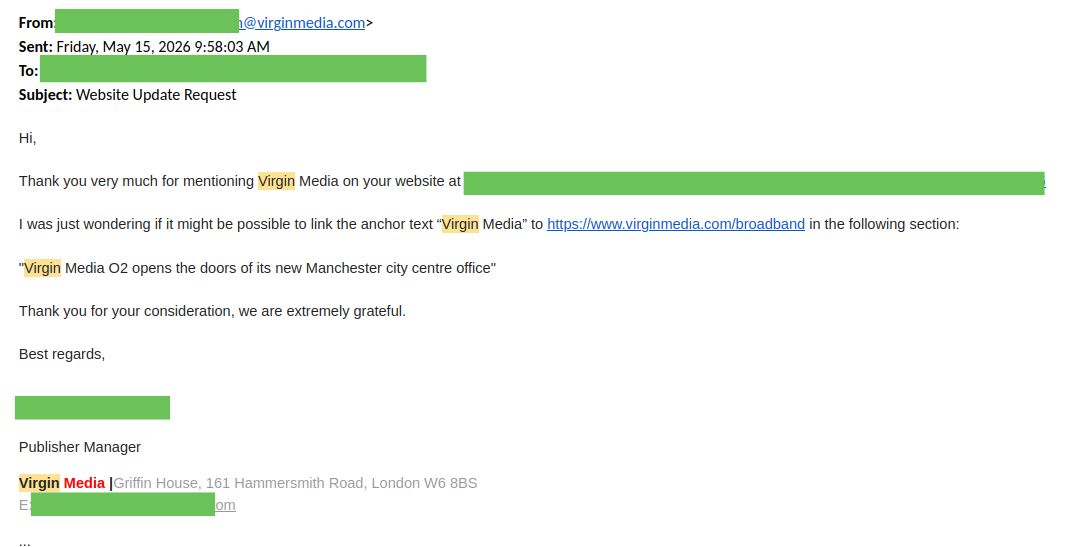
They asked because asking works. So ask.
The checklist
Off-page doesn't tick off as neatly as on-page, since half of it isn't yours to do. But these are the parts you can act on.
The setup
- Google Business Profile claimed, verified and filled out properly
- Name, address and phone identical everywhere they appear
- You know which review platform matters in your niche, and you're on it
- You've searched your own brand name to see what comes up
- You've checked who links to you, and who links to your competitors but not you
The asking
- Every customer gets asked, not just the ones you think will say something nice
- You have an actual moment where the ask happens, at handover, at delivery, on the invoice, and it's the same every time
- Something goes home with them that costs you almost nothing and wasn't expected
- Someone follows up personally a few days later, by name, from a real address
- Replies get answered by a human, including the bad ones
- You have a shortlist of pages that mention you without linking, and you're working through it
- You've asked at least one person for a link this month
The thing only you have
- You're active somewhere your customers actually talk
- You publish on at least one channel you own
- You've written down at least one thing only you know
- That thing has real numbers in it, or real first hand experience, not a rewritten summary