
Why SEO Is Not Dead: One Screenshot Proves It
This one screenshot proves that everyone who tells you "SEO is dead and AI is the killer" is selling you something.
There are snake oil salesmen out there telling you it's all about AIO, GEO, and whatever acronym gets made up next by people who happen to sell that acronym. So here is one image that tells you everything you need to know.
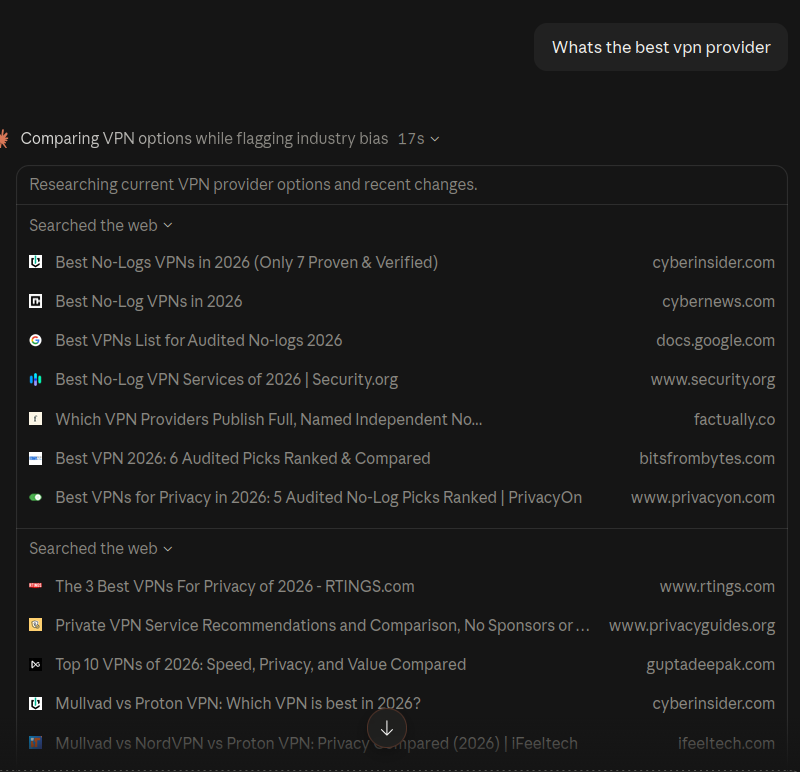
I asked Claude a basic question that most internet users could answer instantly: "What's the best VPN provider?" Claude didn't have the answer in its parametric knowledge, or if you prefer, in its training data.
So it ran a query for me, compiled the results and summarised them.
How did it run that query?
Anthropic does not have a search engine or a ranking algorithm. Claude's web search runs on Brave Search's API. Gemini obviously runs a Google search, and ChatGPT runs a Microsoft Bing query.
The only thing that changed is how the answer is presented to you. The source is still someone's opinion on the web, ranked by a traditional search engine. Same index. Same ranking signals. New front end.
Search engines have gotten smarter, sure. They parse content semantically now instead of scanning your page for keyword density, which to be fair hasn't been the case for quite a while anyway. The principle hasn't changed: what's on your site, and what the rest of the internet says about you. If you want the full picture, read How Google actually works.
Which means that if you want to show up in an AI answer, you still need to show up in search. And for that you still need strong off-page SEO. There's a whole lesson on it: Off-page SEO, everything you don't control.
Now here is the part that will break you
Let's see how many of those researched posts were meaningful and unbiased. I asked.
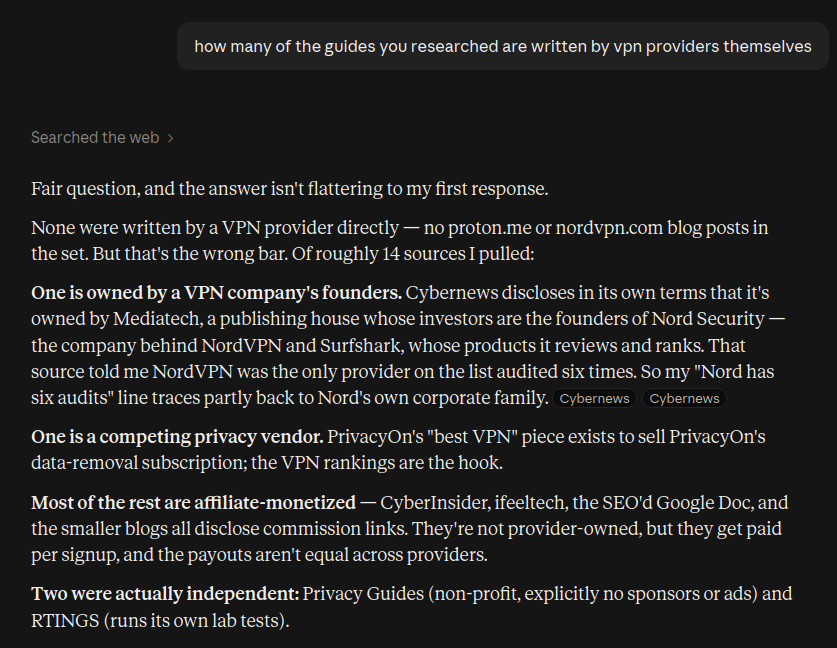
This is one of the most competitive niches on the internet. We are, what, three years into the "AI revolution"? And the smartest chatbot available got manipulated by the oldest trick in the SEO book: sponsored posts and guest posts.
Its top pick came from a "review" site owned by the investors behind the product it reviewed. The rest were affiliate links, where the site earns a commission on every signup and the payouts differ by provider. Two out of fourteen were doing their own testing.
AI chatbots do not have opinions
They can only summarise what people have said somewhere. A chatbot will not buy ten subscriptions from different providers and run the tests for you. At least not yet.
An AI can lean on exactly two things. The first is its training data, and it will answer from that only for the most general questions:
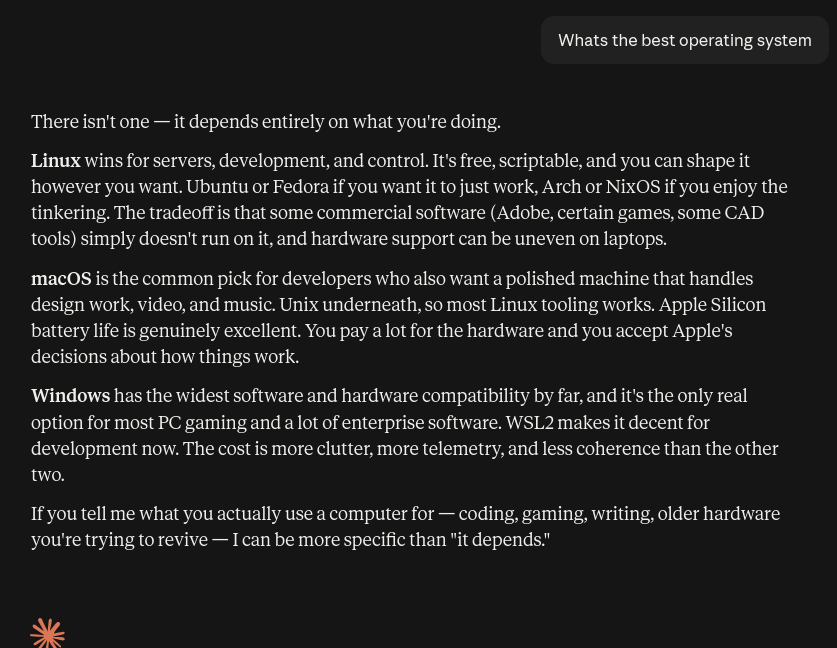
The second is running a web query and summarising the results. That is where every specific, commercial, "which one should I buy" question ends up. And that is search.
It does change the landscape. You need stronger signals to rank than you did five years ago. But it does not break SEO. Quite the contrary, it builds on it.
Don't trust me? Maybe you will trust Google:
"The best practices for SEO continue to be relevant because our generative AI features on Google Search are rooted in our core Search ranking and quality systems. These features rely on AI techniques to highlight content from our Search index."
Source: Google's guide to optimizing for generative AI features on Google Search
Paying for good press is and will remain valuable. The cheapest press you can get is your own customers writing reviews on your Google Business Profile or a review aggregator.
If you run a business with a real address, this is even better news than it sounds. When the question is "best ski shop in Boston", the chatbot runs a search, and Google's job is to find a ski shop in Boston. Your reviews, your profile and the mentions you've earned are the whole input. Nobody can pay their way past a hundred real reviews in your own town. That's the whole argument of lesson one: Why you should do SEO.
So please, for the love of god, do not hire people who tell you SEO is dead. They will run skewed AI prompts to show you that you keep improving while you keep paying. That is not going to lead to any meaningful results for you. It will get them quite far ahead, right up until everyone catches up on it and they move on to the next acronym.
If you'd rather learn what actually moves the needle, read How Google actually works, then work through the SEO Guide for Business Owners. It's free, and none of it expires with the next model release.